

Crop-Specific Guides
Balangu & Basil Seed Production Under PQNK
A complete Punjab-focused production guide showing how Balangu (Lallemantia royleana) and Basil seed crops are grown on PQNK's permanent raised-bed system, from hardpan-breaking through harvest and storage.
Abstract
Balangu and Basil are high-value medicinal and aromatic seed crops with growing food, pharmaceutical, and cosmetic demand, yet this guide treats their production not as a fertilizer-and-spray schedule but as an application of the same four-step PQNK sequence used for any crop: breaking the hardpan where present, correcting soil pH above roughly 8.0 with the sulfuric acid protocol, constructing permanent 42-inch raised beds with 18-inch furrows and 8-inch furrow depth, and never disturbing the bed again once established.
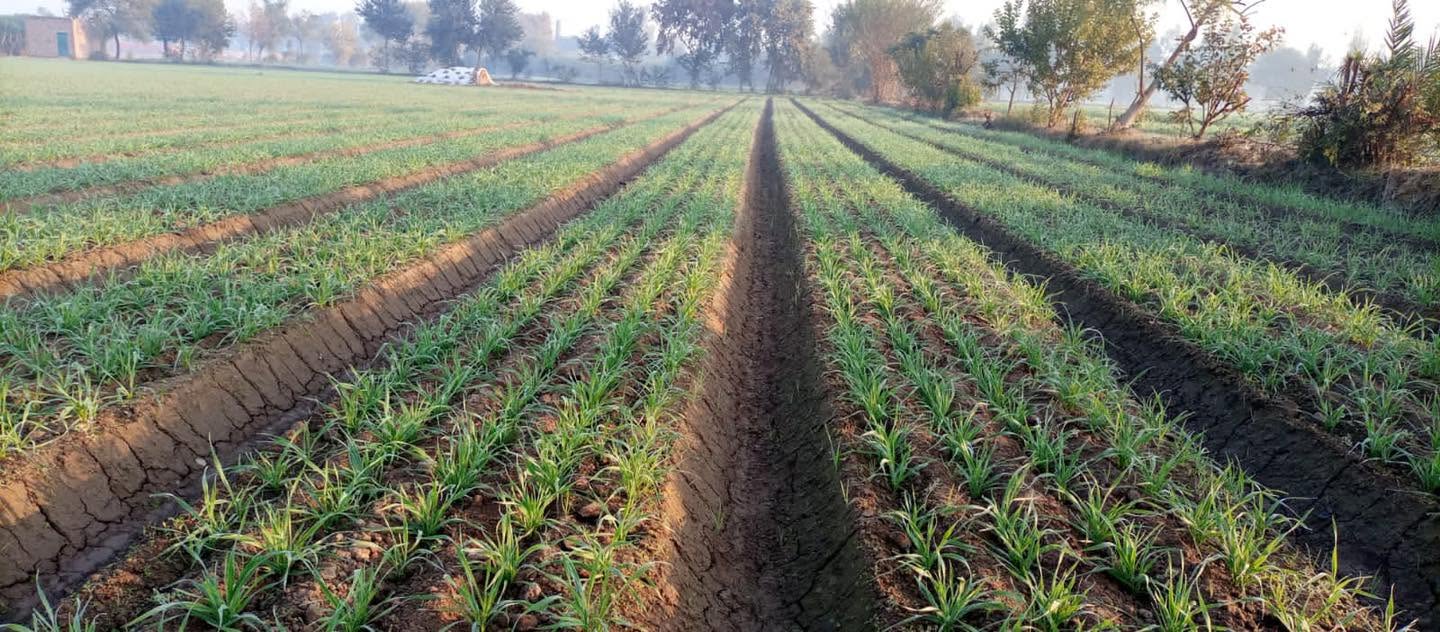
Both crops prefer well-aerated, fast-draining soil with active biology, conditions the permanent bed supplies directly. Seeds go in through intact mulch with the Slit Insertion Precision Planter (SIPP), which plants five rows per pass on the 42-inch bed; a second, offset pass raises this to nine uniformly spaced rows where higher plant populations are wanted, with the choice between five and nine rows depending on seed size, target population, expected rainfall, and harvest method.
For Punjab conditions the guide sets out concrete windows: Balangu is sown October-November, flowers February-March, and is harvested March-April; Basil grown as a seed crop is sown February-March, flowers May-June, and is harvested June-July. In-row spacing runs roughly 2 to 6 inches depending on final plant architecture, and irrigation is applied only into the furrows, never onto the bed top, so that moisture reaches the root zone by lateral capillary movement while maintaining the vattar-wafsa air-water balance the guide treats as central to root and microbial health.
Nutrition under a matured bed comes from mycorrhizal fungi and bacteria mobilizing the soil's own geological mineral reserve rather than from routine fertilizer or compost applications, weeds are treated as a successional indicator rather than a target for chemical control, and pest pressure is managed by the beneficial-insect community a diverse, undisturbed field supports. The guide closes by generalizing from these two crops to the wider claim that once the ecological preconditions are established, only planting geometry and seasonal timing need adjusting for any other crop, soil type, or climate.
About This Paper
- Crop
- Balangu · Basil
- Problem
- Saline / Alkaline / High-pH Soil · Hardpan · Weed Pressure · General Pest Pressure
- Science
- Soil · Water · Biodiversity · Production Architecture
- Evidence
- Scientific Mechanism
- Authority
- Current / Approved PQNK Knowledge
Related PQNK Science
Key Takeaways
- Standard PQNK bed geometry is a 42-inch bed top with an 18-inch furrow top and 8-inch furrow depth, matching the tractor tire spacing common in Punjab.
- The SIPP planter seeds five rows per bed in a single pass, or nine rows with a second offset pass, chosen by seed size, target population, and harvest method.
- Balangu is sown October-November and harvested March-April; Basil seed crop is sown February-March and harvested June-July, with local dates adjusted for seasonal temperature.
- Irrigation is applied only into furrows, never flooded onto the bed, so moisture and dissolved nutrients move laterally into the root zone while the bed centre stays aerated.
- In-row spacing runs roughly 2 to 6 inches depending on desired final population and branching habit, chosen for canopy closure, air circulation, and uniform seed maturation.
- Mature PQNK fields are expected to need neither synthetic fertilizer nor routine compost, since mycorrhizal fungi and bacteria draw nutrition from the soil's existing mineral reserve.
Related Knowledge
same problem
Motha Grass (Cyperus rotundus) Dominance: A PQNK Knowledge Paper
Conventional agronomy calls motha grass a 'cancer weed' to be eradicated with herbicide, but this paper reframes its aggressive spread as a diagnostic signal, an emergency-response species that colonizes exactly the compacted, oxygen-starved, biologically dead soils that herbicide and tillage create in the first place.
same problem
Chilli Production Under PQNK (PICNIC)
Chilli is biologically perennial and can remain productive for over a decade, but conventional short-cycle, urea-dependent management collapses that potential into a pest-prone annual grind. This paper shows how PQNK's soil-conversion framework and a single apical-pinching intervention restore chilli to a low-cost, high-density perennial crop, validated on a Hafizabad farm.
same problem
The Healer's Dialogue: From Weed Signal to Soil Silence — A PQNK Pathway to Self-Regulating Abundance
Responding to a farmer's question about using weeds as nutrient-deficiency indicators, this dialogue explains that in PQNK the goal isn't to manage weeds as permanent indicator crops, but to run a four-step protocol that resolves the soil problems they signal so the weeds voluntarily depart.
same problem
Managing the Biological Transition: Protecting Crop Performance During the First Years of PQNK Conversion
The engineering side of PQNK conversion, hardpan breaking, bed formation, cover cropping, can be finished in weeks, but the soil biology that actually runs the system takes longer to rebuild. This paper explains why the first few crops need closer monitoring, and lays out the minimal, symptom-triggered temporary support (never a return to routine chemical use) that carries a farmer through that gap without abandoning PQNK.