
Published July 25, 2026
Fruit Tree Alleys and Filler Crops on PQNK
This design paper lays out a one-acre PQNK layout that interplants date palm, citrus, guava, mango, grapes, ginger, and fig in permanent raised-bed fruit alleys alongside dedicated vegetable beds, modeling roughly PKR 165,000 in establishment cost against over PKR 1.3 million in projected annual income.
Abstract
The paper applies PQNK's closed-loop philosophy, no fertilizer, no pesticide, up to 80% less water, and low seed and labor input, to a mixed-species one-acre design that alternates permanent raised beds of fruit trees with dedicated vegetable crop beds. It frames the layout as a complete farm ecosystem rather than a single-crop orchard, designed to generate income from fast-cycling vegetables while the longer-lived fruit trees mature into full production.
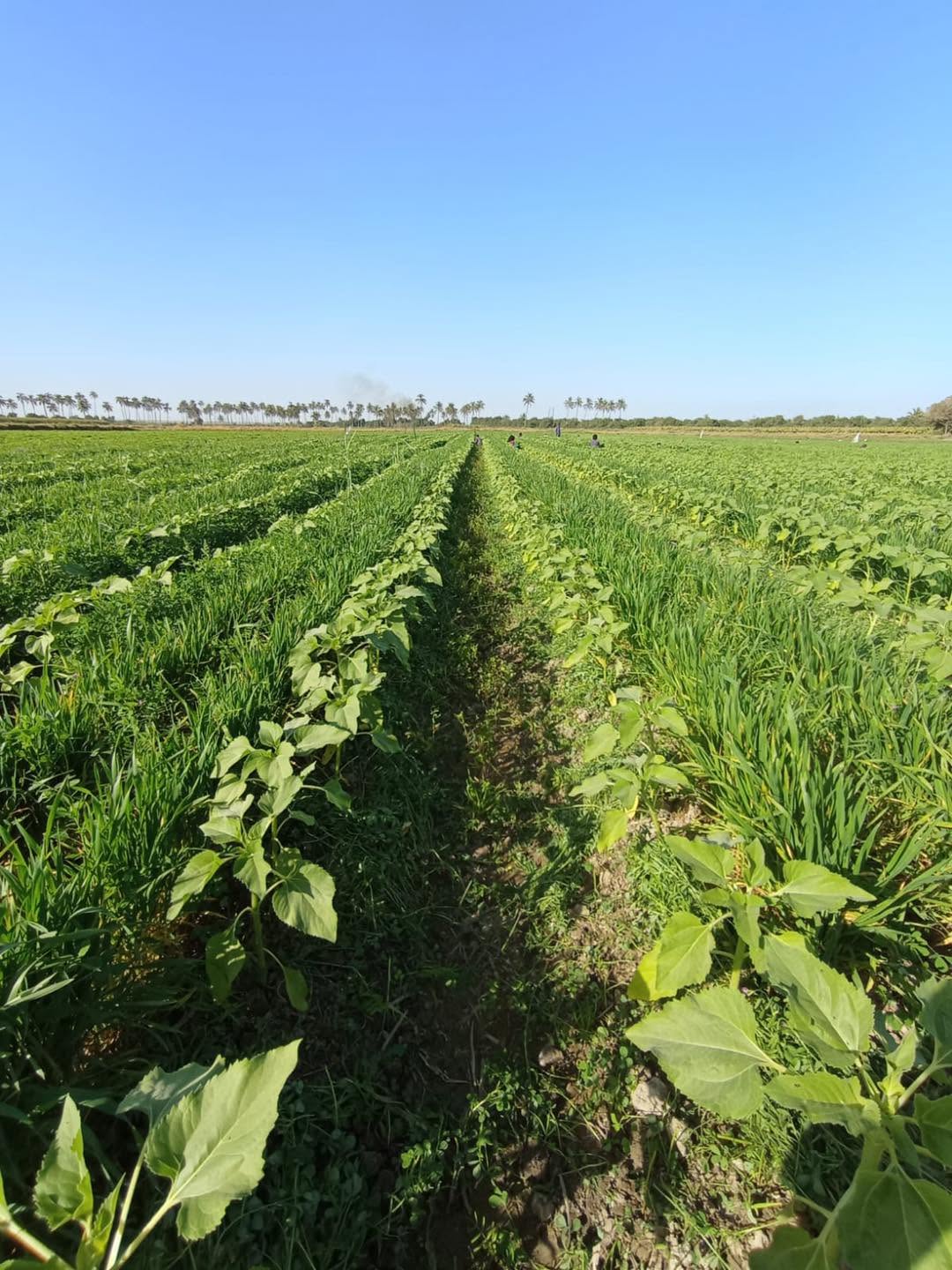
Zone A carries the fruit planting: 1,854 total plants across seven species, date palm, citrus, guava, mango, grapes, ginger, and fig, each assigned a canopy width and height, and a defined sowing, pruning, and fruit-picking calendar. Zone B is reserved for rotating filler crops grown in the open beds between the fruit rows while canopies are still young, including cucumber, tomato, green chilli, turmeric, capsicum, bitter gourd, sweet potato, garlic, potato, melon, onion, broccoli, cabbage, lemongrass, and bottle gourd and other creeper crops, with the exact mix left to adjust by farmer, location, and season.
Physically, the layout alternates fruit-plant beds and crop beds separated by permanent and temporary water channels, with defined 42-inch and 8'6" bed profiles and a minimum 5-6 inch organic mulch layer covering the growing surface. The paper includes elevation and section detail for both bed types, showing raised-bed geometry, mulch depth, and inter-cropping space designed into the physical plan rather than left informal.
The cost estimate itemizes establishment at roughly PKR 165,000 per acre: laser leveling (PKR 10,000), deep ploughing (PKR 5,000), water wash and ploughing (PKR 5,000), bio-organic compost (PKR 20,000), permanent raised beds (PKR 10,000), cover crop and mulching (PKR 15,000), main power (PKR 25,000), fruit plants (PKR 50,000), and other crops (PKR 25,000), with a note that costs vary by location and time.
On the income side, the paper models per-plant and per-acre yield and price for each fruit species, projecting roughly PKR 1,324,800 in gross income per acre once the mix matures, led by mango and guava at PKR 340,000 each, citrus at PKR 170,000, date palm at PKR 256,000, ginger at PKR 200,000, grapes at PKR 60,000, and fig at PKR 12,800. It closes with practical notes urging farmers to brand and market their own produce directly for higher margins, and flags the One Acre Prosperity (OAP) model as a way to further raise returns from the crop beds not included in this baseline estimate.
Key Takeaways
- The design plants 1,854 fruit trees and crops per acre across seven species (date palm, citrus, guava, mango, grapes, fig, ginger) on permanent raised beds in dedicated fruit alleys.
- Vegetable filler crops (tomato, chilli, garlic, potato, melon, onion, and others) occupy the space between young fruit trees before canopy closure, generating early income from otherwise idle land.
- Modeled establishment cost is roughly PKR 165,000 per acre, covering laser leveling, deep ploughing, compost, raised beds, cover-crop mulching, and planting material.
- Modeled gross income reaches roughly PKR 1,324,800 per acre once the mixed planting matures, led by mango and guava at PKR 340,000 each.
- The layout uses permanent and temporary water channels running between alternating fruit and crop beds, with 5-6 inches of organic mulch across the growing surface.
- The paper recommends farmers brand and market their own produce directly, and points to the One Acre Prosperity (OAP) model as a way to further raise returns from the interspersed crop beds.