
Published July 25, 2026
Restoring Prosperity in Citrus and Mango Orchards Through the PQNK Regenerative System
Decades of industrial orchard management have driven a 60% decline in Kinnow nutrition density and widespread orchard abandonment. This paper presents field data from a Toba Tek Singh comparison and the Sujjahabad Mango Research Station showing how PQNK reverses that decline, lifting A-grade fruit yield by up to 80%.
Abstract
Citrus and mango orchards have been in steady decline for over 30 years under industrial management. Input costs have risen sharply even as yields fall, nutrition density in key varieties such as Kinnow has declined by as much as 60%, affecting taste, market value, and health benefit, and mounting farmer distress has led to widespread orchard abandonment and uprooting. The paper traces this crisis to specific, identifiable practices: excessive irrigation that destroys soil structure and depletes oxygen, tillage implements such as spring tine cultivators that create a compacted hardpan restricting root growth and water infiltration, and bare, chemically dependent soil that erodes biodiversity and destroys the soil microbiome.
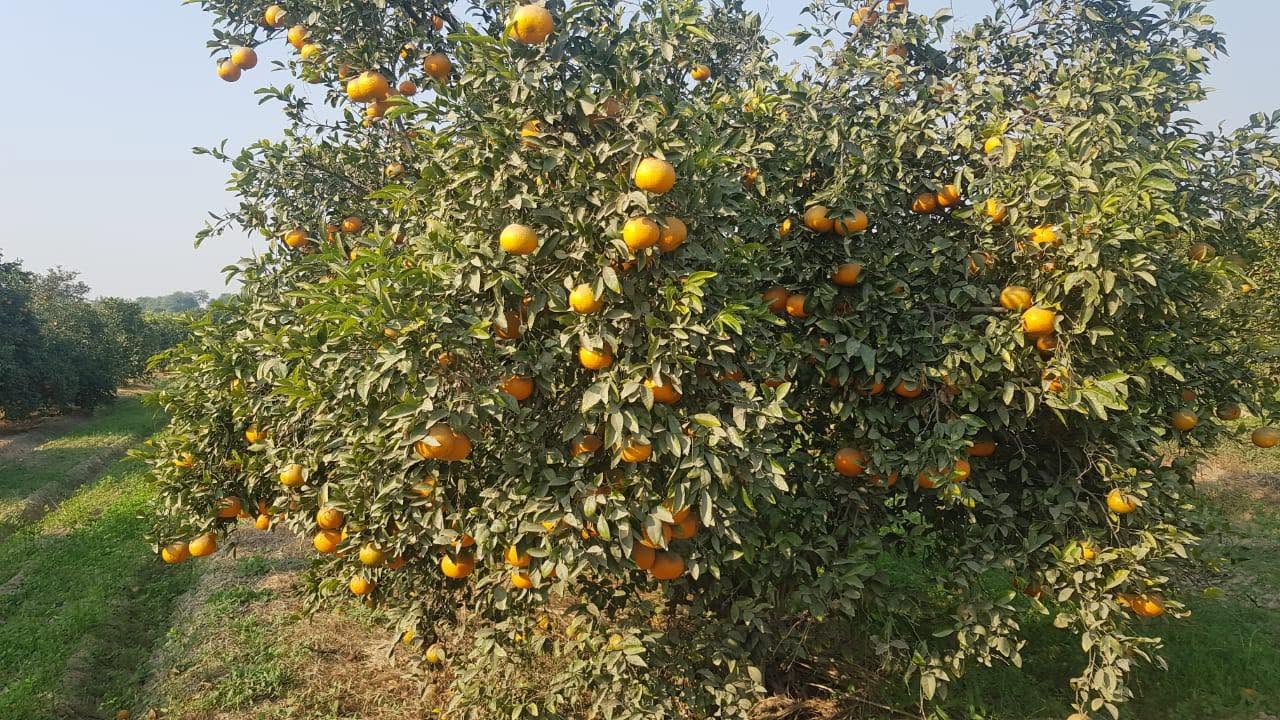
PQNK is presented not as a theoretical alternative but as a field-validated recovery method, anchored by two documented cases. At the Sujjahabad Mango Research Station, an orchard facing imminent collapse was converted to PQNK management and showed remarkable recovery within a few months. A more systematic comparison from Toba Tek Singh set conventional and PQNK Kinnow orchards side by side, generating the paper's core quantitative evidence.
That comparison shows PQNK orchards operating at significantly lower annual cost per acre than the conventional PKR 80,000-200,000 range, with markedly lower disease pressure requiring far less chemical intervention. A-grade fruit yield rises from 40-50% under conventional management to 70-80% under PQNK, and net return per acre climbs from PKR 300,000-400,000 conventionally to a substantially higher PKR 500,000-800,000 under PQNK. Fruit quality metrics follow the same pattern: longer shelf life, dark green and healthy canopies versus stressed, prematurely ripening ones, and more uniform fruit maturity with better internal seed development.
On pest and soil management, the Toba Tek Singh data show near-zero fruit fly damage under PQNK versus severe infestations conventionally, with mealybugs controlled by robust natural predator populations such as ants rather than costly, low-result chemical sprays. PQNK orchards also show visible mycorrhizal fungi activity — mushrooms appearing after rain — as a direct sign of the biological soil health driving nutrient cycling and disease resistance. Rehabilitated orchards are reported recovering fully, while 5-year-old high-density PQNK orchards are on track to outperform conventional orchards 'by several multiples' once they reach full production in year six.
The paper concludes that the citrus and mango crisis is a direct consequence of broken agricultural ecosystems, not an inevitable feature of the crops themselves, and that the Sujjahabad and Toba Tek Singh evidence together make the case for widespread PQNK adoption as the path to environmental sustainability, economic prosperity through drastically lower costs and higher-value yield, and market leadership through nutrition-dense, long-shelf-life produce that surpasses organic standards.
Key Takeaways
- Industrial orchard management has driven a 60% decline in Kinnow nutrition density and widespread orchard abandonment over the past 30 years.
- A Toba Tek Singh field comparison shows PQNK lifting A-grade fruit yield from 40-50% to 70-80%.
- Net return per acre rises from PKR 300,000-400,000 conventionally to PKR 500,000-800,000 under PQNK.
- PQNK orchards show near-zero fruit fly damage and natural mealybug control via predator populations like ants, replacing costly chemical spraying.
- The Sujjahabad Mango Research Station orchard, facing imminent collapse, showed remarkable recovery within a few months of PQNK conversion.
- Five-year-old high-density PQNK orchards are projected to outperform conventional orchards by several multiples once mature.