
Published July 25, 2026
The Future of Potato Cultivation: A Scientific and Economic Comparison of ACI, Global Best Practices, and the PQNK Framework
Conventional potato farming traps growers in a cycle of high input costs, a hard yield ceiling near 14 tonnes per acre, and boom-bust pricing. This paper compares conventional (ACI), Global Best Practice, and PQNK potato systems on plant physiology, economics, and risk, and lays out a year-by-year transition pathway for farmers.
Abstract
The paper opens with a diagnostic image: soil that feels dead, lifeless, and inert in the hand is the signature of a collapsed system. Conventional 'Ancient Conventional Industrial' (ACI) potato farming produces exactly this, through compacted earth that repels water rather than absorbing it, plants left susceptible to disease, chemical runoff, and tubers that are often tasteless, less nutritious, carry chemical residues, and store poorly. PQNK's founding premise is the opposite: that soil is a living, breathing organism whose original design — teeming with microbial life, rich in organic matter, properly moist and aerated, buffered against temperature extremes — must be restored before the plant can reach its genetic potential.
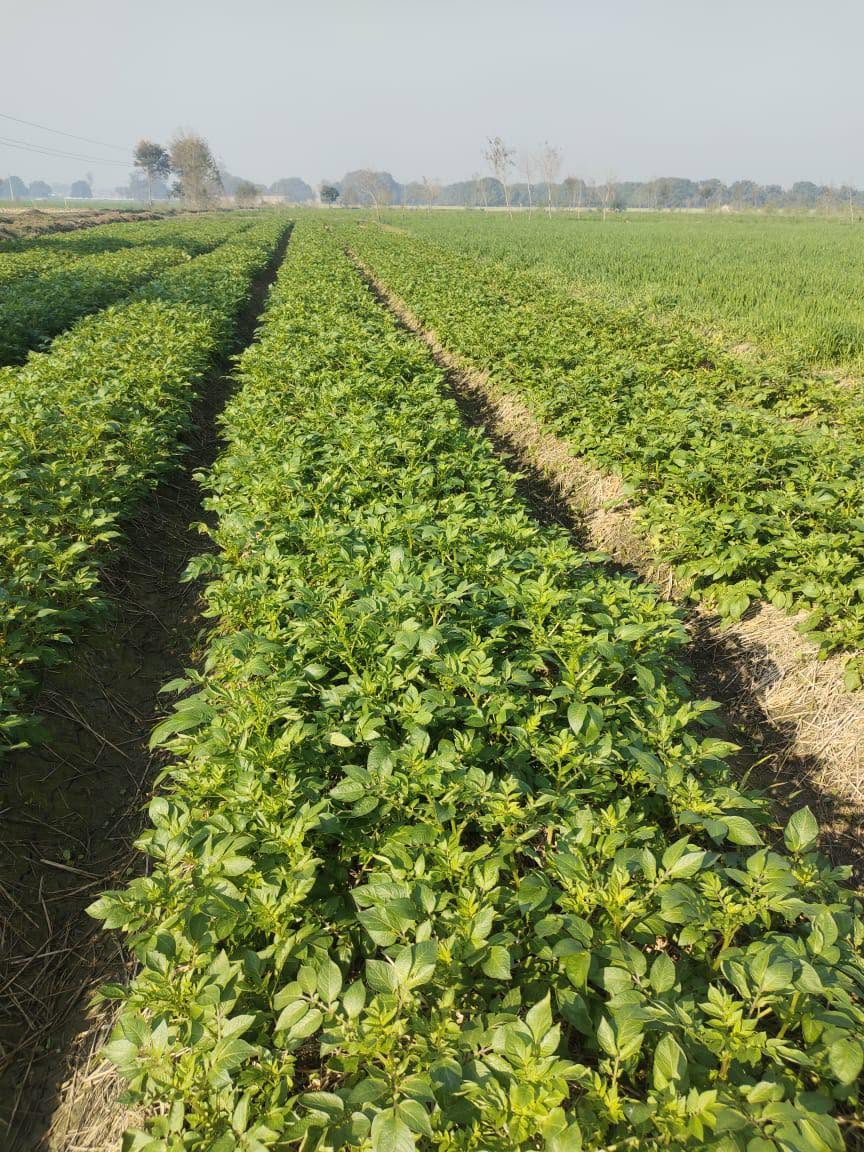
The paper grounds its argument in potato physiology. Tuber initiation and bulking depend on soil temperature in the 13°C-26°C range, consistent moisture, and day length; under vigorous PQNK growth, farmers use a technique called 'vine pressing' 25-30 days after germination, gently pressing vines with a plank or roller to signal the plant to stop vegetative expansion and begin tuber bulking. Potatoes also need a well-aerated root zone for tuber expansion (compacted soil stunts growth) and a steady nutrient supply rather than the boom-and-bust dosing typical of synthetic fertilizer. The paper describes a healthy source-sink relationship, where photosynthesizing vines (the source) fuel tuber development (the sink), a flow easily disrupted by heat, frost, or drought stress. It also details the soil microbiology underpinning all of this: mycorrhizal fungi extending root uptake of water and phosphorus, and beneficial bacteria fixing nitrogen and solubilizing minerals — biology that ACI practices destroy and PQNK actively cultivates.
On economics, ACI potato production carries heavy recurring costs: roughly 1,500 kg of seed per acre, 3-6 bags of fertilizer, 10-15 cultivation passes, and ongoing chemical spend, capping yield near 14 tonnes per acre. PQNK shifts the cost structure toward one-time or periodic investment in organic mulch and bed establishment rather than annual chemical purchases, while a denser stand of roughly 50,000 healthier plants, a longer growing window, and better growing conditions push past the ACI yield ceiling with tubers that are more flavorful, chemical-residue-free, and longer-storing due to mineral density and stronger skins. The paper frames PQNK's biggest economic advantage as risk reduction: buffering against heat, cold, and drought de-risks farming from climate variability, and freedom from volatile fertilizer and pesticide markets further stabilizes farm income, while PQNK's stable soil environment even opens the door to near-perennial, staggered production that lets farmers sell fresh potatoes year-round at off-season premium prices.
A year-by-year transition pathway is laid out for farmers moving off ACI. In year one: level the field with minimal disturbance while breaking the ACI-era hardpan for deep root growth and infiltration; form permanent 42-inch-wide raised beds; grow cover crops (legumes for nitrogen, deep-rooted species to break compaction) to restore organic matter and kickstart microbial life; plant the first potato crop under a thick organic mulch layer; and monitor closely, supplementing inputs only if an extreme situation demands it. From year one onward, the soil becomes a self-sustaining, largely closed-loop ecosystem, with management shifting to maintaining mulch, rotating crops on the permanent beds, and observing the natural balance as yields stabilize high and costs stay low.
The paper concludes that ACI agriculture is a high-risk, degenerative dead end, that Global Best Practices offer real but incomplete improvement while remaining input-dependent, and that PQNK represents the necessary evolution toward a resilient, profitable, ecologically sound system — a shift from dominating nature to collaborating with it. It urges farmers, extension officers, and policymakers to start the transition on a small portion of land and let the results speak for themselves.
Key Takeaways
- ACI potato farming caps out near a 14 tonne/acre yield ceiling; PQNK is positioned to break through it via roughly 50,000 healthier plants per acre and a longer growing window.
- 'Vine pressing' 25-30 days after germination — gently pressing vines with a plank or roller — signals the plant to shift energy from vegetative growth into tuber bulking.
- PQNK shifts costs from recurring annual chemical inputs (1,500 kg seed, 3-6 fertilizer bags, 10-15 cultivations under ACI) to one-time or periodic mulch and bed investment.
- PQNK's stable soil environment opens the door to near-perennial, staggered production, letting farmers sell fresh potatoes year-round at off-season premium prices.
- PQNK-grown tubers are described as more flavorful, chemical-residue-free, and longer-storing due to mineral density and stronger skins.
- A defined year-one transition sequence covers hardpan-breaking, permanent 42-inch bed formation, cover cropping, and mulch-covered planting.