

Published July 25, 2026
Knowledge Paper: The Principle of Permanent Confinement – The Mechanical-Synchrony Foundation of PQNK Bed Geometry
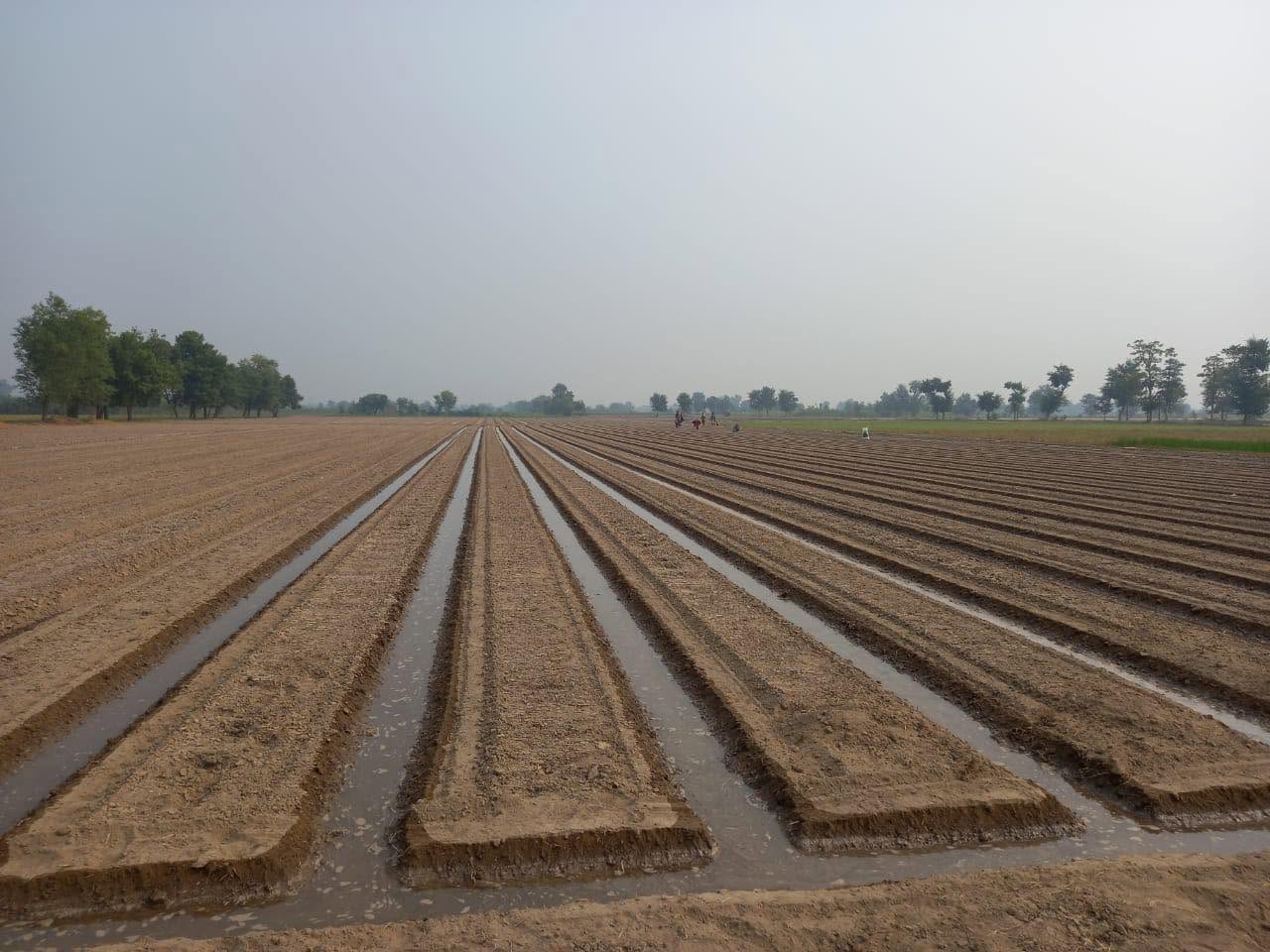
PQNK bed and furrow dimensions are not chosen for tradition or aesthetics, they are derived mathematically from tractor wheel-track spacing and tire width so that machinery is permanently confined to the furrows and never crosses the growing bed. This paper sets out that engineering logic, the five-step establishment sequence that eliminates germination problems, and a recalculation table for adapting bed width to different tractors, soils, and rainfall zones.
Abstract
Conventional field design starts by asking how wide a bed should be. PQNK inverts that question entirely: it starts by asking how machinery movement can be confined permanently outside the biological production zone, and treats bed width as a derived variable that follows from that answer rather than an arbitrary or traditional starting point. The paper's central claim is that PQNK's now-familiar 42-inch bed top and 18-inch furrow top are not universal dogma but one successful solution to a specific mechanical equation involving common 55-90HP two-wheel-drive tractors, their roughly 60-inch rear wheel-center spacing, and typical 13-inch rear tire width, so that a tractor's rear wheels naturally track the furrows on both sides of the bed without deviation.
The paper also corrects what it calls a previous drafting error: the assumption that PQNK beds face a 'germination difficulty' because moisture must travel from the furrow to a dry bed center. It replaces that assumption with a five-step establishment sequence, break the hardpan, water-wash the soil to settle particles and leach salts, wait for workable moisture, pulverize once with a single final tillage pass, then seed and form beds, either broadcasting onto pulverized moist soil before bed formation or forming beds first and planting into them. Because the entire bed volume is already moist at the moment of formation, seeds germinate in that residual moisture and roots are already developing by the time it depletes; there is no germination problem when the sequence is followed correctly, and this is the final tillage event the field ever undergoes.
After establishment, the paper describes a deliberately engineered gradient hydrology rather than uniform moisture: furrows serve as the water source, bed edges see high moisture and nutrient exchange, and the bed center holds moderate, dense moisture with high aeration where roots have already colonized. Roots are described as motile and exploratory rather than passive, bridging the gradient themselves, so the plant does not require uniform edge-to-edge moisture, only a connected root system and functional pore network, both of which the establishment sequence and any cover-crop rooting create.
A significant portion of the paper addresses adaptability: the standard 42-inch configuration is optimized for controlled irrigation and moderate rainfall, but in rain-fed areas with non-sandy soils, beds can widen to 48-60 inches or more provided tractor track spacing is recalculated to match. A worked recalculation table gives specific furrow and bed-top dimensions across five scenarios, from a narrow 33-inch hillside configuration to an 80-inch rain-fed wide-bed configuration, with the rule that furrow width should always exceed tire width by roughly 5 inches for guidance tolerance and sidewall clearance.
The furrow itself is framed as a multi-functional corridor serving five inseparable roles simultaneously: hydraulic conveyance, traffic guidance, compaction localization, machine alignment, and structural boundary protection for the undisturbed bed. The paper's conclusion states that once traffic lanes are fixed and the establishment sequence is complete, compaction becomes permanently localized to the furrow corridors while the raised bed accumulates organic matter, porosity, and biology undisturbed season after season, and calls for this confinement principle, not any specific measurement, to be treated as the permanent architectural logic of the PQNK Bed System.
Key Takeaways
- PQNK bed geometry is derived from tractor wheel-track spacing and tire width, not chosen arbitrarily: the standard 42-inch bed/18-inch furrow configuration is a mechanical solution for common 55-90HP tractors with ~60-inch rear wheel-center spacing and 13-inch tires.
- Corrects an earlier draft's error: there is no inherent 'germination difficulty' in PQNK beds. A five-step sequence, break hardpan, water-wash, reach workable moisture, pulverize once, then seed and form beds, leaves the whole bed moist at establishment so seeds germinate without difficulty.
- After establishment, lateral gradient hydrology moves water from furrow to bed center by design; roots are described as motile and exploratory, bridging the moisture gradient themselves rather than requiring uniform moisture.
- Bed width is adaptive, not fixed: rain-fed, non-sandy fields can run 48-60+ inch beds provided furrow spacing is recalculated to match the tractor's actual track geometry, with furrow width always exceeding tire width by roughly 5 inches.
- The furrow is framed as a multi-functional corridor performing five roles at once: hydraulic conveyance, traffic guidance, compaction localization, machine alignment, and structural boundary protection.
- The governing principle is permanent confinement of machinery to furrow corridors, not any specific dimension; once traffic lanes are fixed, compaction stays localized while the bed zone accumulates organic matter and biology undisturbed indefinitely.