

Crop-Specific Guides
Achieving High Yields in Potato Cultivation within Mature PQNK Systems
A short field advisory for farmers whose PQNK soil has matured to the point where potato plants grow vigorous vines but underperform on tubers, explaining the hormonal mechanism behind excess vegetative growth and giving two concrete practices, wider plant spacing and a timed mechanical vine-pressing pass, to redirect that energy into yield.
Abstract
In a mature PQNK system, soil is constantly moist, well aerated, and biologically supplied with balanced nutrients, removing the stresses (drought, compaction, nutrient swings, pest and disease pressure) that a conventional potato plant must constantly manage. The advisory's starting observation is that this near-ideal environment can backfire in one specific way: the potato plant's hormonal balance shifts toward vegetative growth, producing vigorous vines at the expense of tuber bulking, since the plant is no longer under any stress signal to prioritize reproduction.
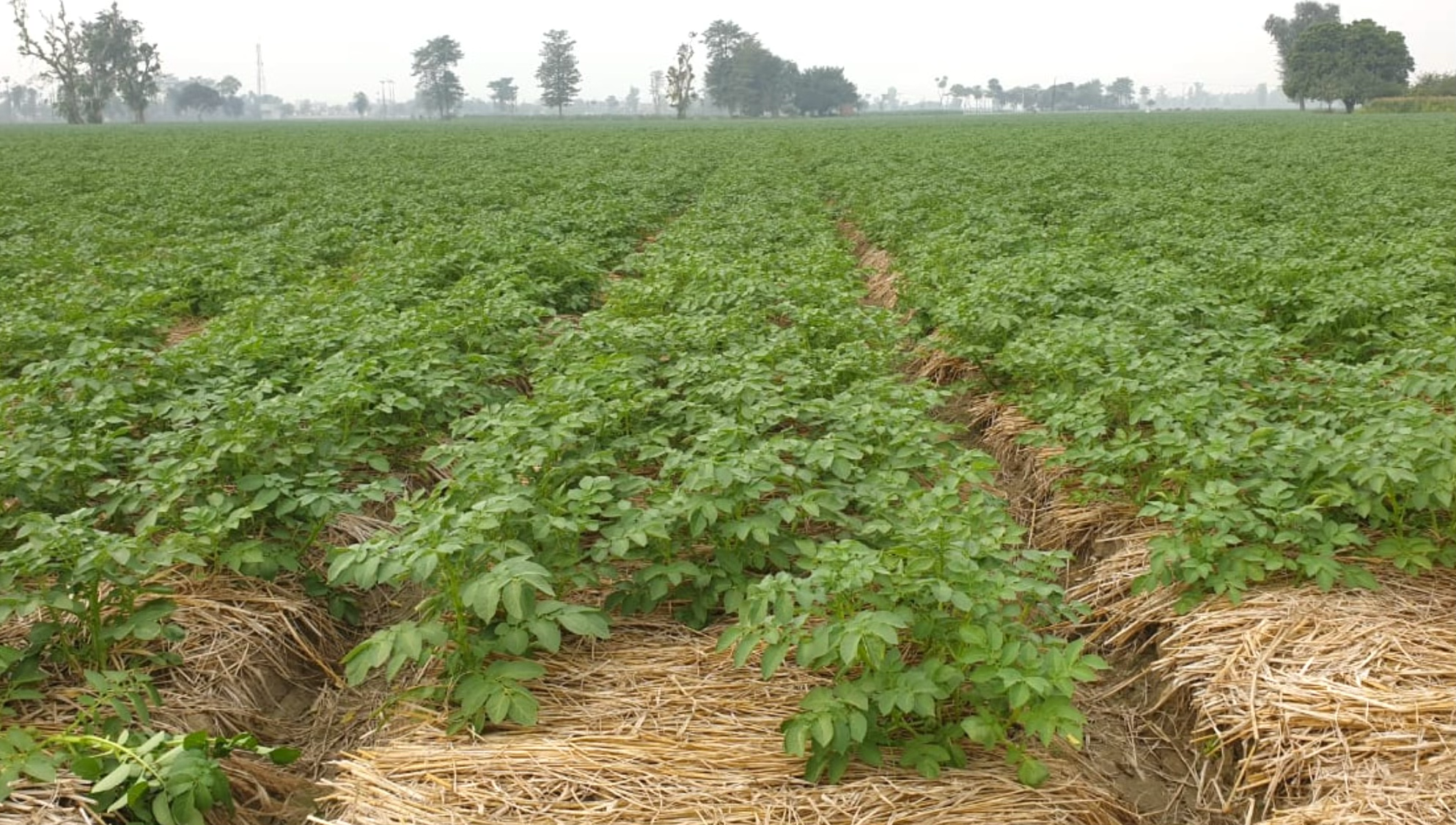
The recommended fix is not to add fertilizer or water but to manage plant architecture and hormonal signaling directly, through two practices. First, spacing: three rows per standard 42-inch bed with an 8-inch distance between seed pieces within the row, giving each plant enough light and space to build an efficient, non-shading canopy rather than a tangled one. Second, a physical nudge: a lightweight wooden roller or plank is passed once over the bed roughly 25-30 days after emergence, when vines are 12-18 inches long, gently pressing and flexing (not crushing or cutting) the vines.
The mechanism is explained as mechanical stress signaling, a technique the paper notes is already proven in peanut and sweet potato: the gentle pressure triggers a hormonal shift that slows vegetative growth and diverts sugars toward tuber initiation and bulking, while a smooth tool applied without injury avoids triggering a compensatory vegetative growth surge that a wounded plant would otherwise mount to regrow damaged tissue.
A season summary lays out the full protocol: plant 3 rows per bed at 8-inch by 3-inch spacing under mulch; apply no fertilizer in a mature bed unless deficiency appears, in which case a maximum of 4 kg NP (or a 2% NP foliar solution) is permitted, with urea or other nitrogen explicitly prohibited after 25-30 days post-emergence; roll the vines once around day 25; and maintain mulch cover with siphon-tube irrigation and ethanol spray for frost protection as needed through to harvest.
About This Paper
- Crop
- Potato
- Problem
- Excess Vegetative Growth (at expense of yield/flowering) · Yield Stagnation / Decline · Preventive/Prophylactic Over-Application of Inputs (Fertilizer/Nitrogen)
- Science
- Plants · Soil
- Evidence
- Scientific Mechanism
- Authority
- Current / Approved PQNK Knowledge
Related PQNK Science
Key Takeaways
- In mature, low-stress PQNK soil, potato plants can shift hormonally toward excess vine growth at the expense of tuber bulking, a problem specific to well-functioning systems.
- Recommended spacing is 3 rows per 42-inch bed with an 8-inch distance between seed pieces, reducing shading competition and building a more efficient canopy.
- A single pass with a smooth wooden roller or plank, applied 25-30 days after emergence when vines are 12-18 inches long, mechanically signals the plant to redirect energy from vines to tubers.
- The roller/plank must press and flex vines without breaking stems or leaves; injury triggers a compensatory vegetative regrowth response that works against the intended effect.
- No fertilizer is needed in a mature bed; if deficiency appears, the maximum permitted input is 4 kg NP (or 2% NP foliar), and nitrogen/urea is prohibited after 25-30 days post-emergence.
Related Crops
Related Knowledge
same problem
PQNK Knowledge Paper: The Twofold Art of Pruning as Compensatory Grazing
With grazing animals absent, plants read the lack of browsing pressure as a sign their foliage isn't wanted and pour energy into ever more vegetative growth instead of fruit. This paper sets out a two-phase pruning protocol, formative and reproductive, standing in for that missing herd, with a detailed crop-by-crop benchmark table and a full sugarcane case study covering two distinct harvest strategies.
same problem
PQNK Advisory: Strategic Pruning of Brinjal (Eggplant) for a Prolific Harvest
This advisory frames brinjal pruning not as damage control but as energy stewardship, walking through a three-phase framework, an early architectural tip-pinch, ongoing canopy-opening cuts, and a mid-season rejuvenation prune, that keeps a closed-loop PQNK bed producing continuous flushes of fruit.
same problem
Sugarcane Cultivation on PQNK: A Perennial, Circular Production System
This companion knowledge paper turns the bamboo-principle reframe into an operating system: selective, year-round harvesting from overlapping generations of cane within the same clump, with rising density treated as a soil-health signal rather than a problem to be thinned.
same problem
The Future of Potato Cultivation: A Scientific and Economic Comparison of ACI, Global Best Practices, and the PQNK Framework
Conventional potato farming traps growers in a cycle of high input costs, a hard yield ceiling near 14 tonnes per acre, and boom-bust pricing. This paper compares conventional (ACI), Global Best Practice, and PQNK potato systems on plant physiology, economics, and risk, and lays out a year-by-year transition pathway for farmers.