

Crop-Specific Guides
PQNK (Pristine Organic Farming) Guide to Wheat Cultivation
A practical farmer Q&A covering seed preparation, an intercropped bed layout combining wheat with corn (for shade), peas, and radish, a three-stage pruning schedule tracked by tiller counts, and irrigation and harvest timing, distinct from PQNK's economics- and lifespan-focused wheat papers in that it is a field-operations manual for bed design and day-to-day management.
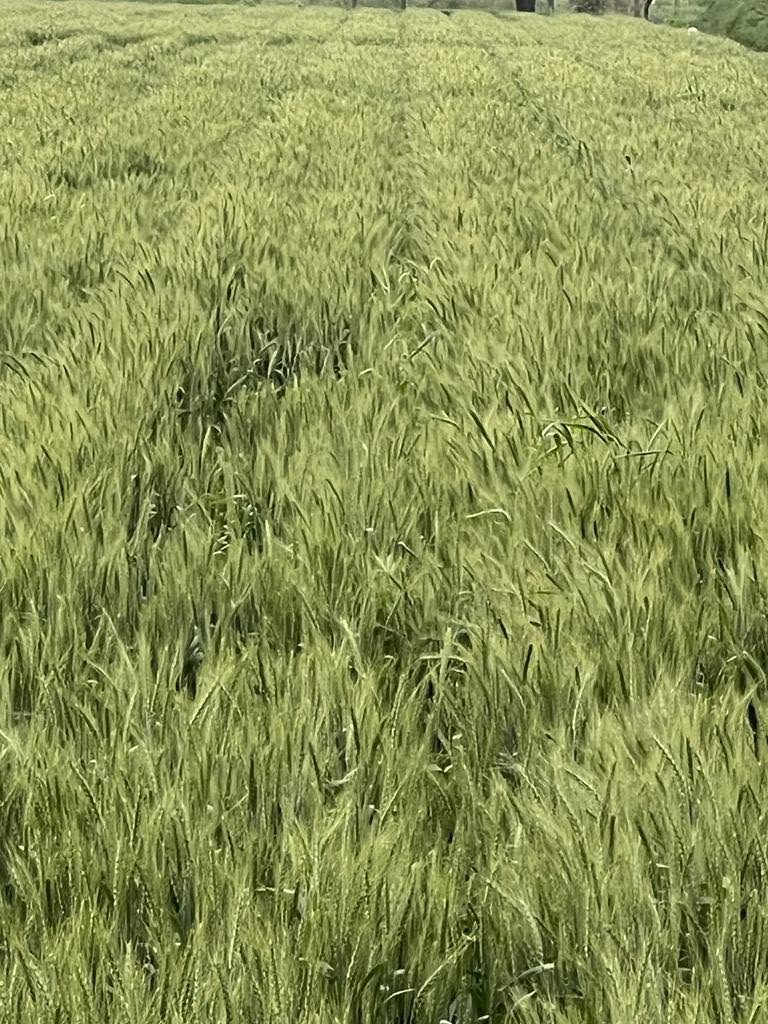
Abstract
Structured as a running Q&A, this guide opens with seed preparation: soaking seed before sowing to kick-start germination (or, where a planter is used, checking soil moisture with a simple soil-ball test), selecting seed visually for plump uniform grains plus a buoyancy sink-test, and noting that seed saved from a farm's own PQNK crop over 2-3 seasons develops a landrace better adapted to the pristine system than bought-in conventional seed. Sowing guidance is minimal-intervention: do not irrigate after sowing if soil is already moist, since added water disrupts soil structure and microbial life unnecessarily.
A distinctive management layer is heat protection via corn intercropping: corn is sown in the last week of February or first week of March, at 1 row of corn for every 4-5 rows of wheat, spaced 1.5-2 feet within the row along the bed edge running north-south, so that by April the corn canopy shades the wheat during its critical grain-filling stage against harsh spring sun, without displacing any wheat rows. Seed density is cut to 8-10 kg per acre with 6-8 inches between seeds (two seeds per hill) on a 42-inch bed, deliberately lower than conventional density since PQNK treats low density as the route to plant strength rather than a yield sacrifice.
The bed layout further intercrops radish and green peas as 'ecological stacking': on a 42-inch bed, 5 rows of wheat plus 2 rows of peas or radish (or 1 of each) run along the furrow edges, for 7 total rows plus the corn row on the furrow side, sown with a no-till planter run twice (first pass for wheat, second pass with re-spaced planter rows for the intercrops). Radish and peas double as microclimate control in October-November, their fast canopy shading the soil and young wheat before the corn canopy takes over the same function in March-April.
Pruning is tracked explicitly by tiller count rather than by calendar alone: first pruning at 25-30 days or 6-8 inches height yields 5-8 tillers, a second pruning yields 15-25 tillers, and a third yields 40-70-plus tillers, with 2-3 total prunings spaced 20-25 days apart and the last one completed by end-December, since pruning after the plant enters its reproductive phase harms yield. Irrigation requirement is cut by 50-70% to roughly 2-4 irrigations through the furrows total, applied only when soil 2-3 inches below the surface feels dry, and harvest is timed to physiological maturity: golden-yellow stalks with a still slightly greenish stem just below the earhead and hard grain.
About This Paper
- Crop
- Wheat · Maize (Corn) · Pea · Radish
- Problem
- Heat Stress on Crop · Poor Tillering · Over-Irrigation · Seed Sourcing / Genetic Vulnerability
- Science
- Plants · Water · Biodiversity · Production Architecture
- Evidence
- Farmer Testimony
- Authority
- Current / Approved PQNK Knowledge
Related PQNK Science
Key Takeaways
- Corn is intercropped as a shading crop at 1 row per 4-5 rows of wheat, sown late Feb/early March so its canopy protects wheat during April grain-filling without reducing wheat row count.
- Wheat seed rate is cut to 8-10 kg/acre at 6-8 inch spacing (two seeds per hill) on a 42-inch bed, deliberately below conventional density to favor plant strength over crowding.
- A 42-inch bed intercrops 5 rows of wheat with 2 rows of peas/radish along the furrow edges (7 rows plus a corn row), sown via a two-pass no-till planter.
- Pruning is tracked by resulting tiller count: 5-8 tillers after the 1st pruning, 15-25 after the 2nd, 40-70+ after the 3rd, with all pruning completed by end-December before the reproductive phase begins.
- Irrigation is cut 50-70% to roughly 2-4 irrigations total, triggered only when soil 2-3 inches below the surface feels dry.
- Harvest timing is read from the plant: golden-yellow stalks with a still slightly greenish stem just below the earhead, and hard grain, defines physiological maturity.
Related Crops
Related Knowledge
same problem
The PQNK Foundation: The Philosophy of the "Central Leader"
A farmer's questions about wheat tillering become the occasion for laying out a core PQNK principle: the plant as a 'Central Leader' system, like a tree, whose apical dominance must be surgically broken to redirect energy into uniform, productive tillers. The paper works through eleven practical questions, from exact pruning height to a full per-acre yield calculation, showing the principle in action.
same problem
Watermelon Cultivation: Pruning, Irrigation, and Trellis Q&A
A farmer's detailed field questions on watermelon pruning ratios, shading with corn, trellis design, plant spacing, and irrigation timing, answered against PQNK's water-mineral and moisture-gradient principles.
same problem
Comprehensive Guidance for Farmers Adapting to Man-Made Erratic Weather Using PQNK Principles
A farmer Q&A collection addressing a delayed, compressed winter season (monsoon arriving early, winter delayed 1-1.5 months) and its effect on wheat, alongside related questions on why weeds outperform crops under drought stress; the wheat section lays out a biology-based, soil-temperature-triggered sowing and pruning protocol built specifically to recover the lost growing time.
same problem
PQNK Knowledge Paper: The Twofold Art of Pruning as Compensatory Grazing
With grazing animals absent, plants read the lack of browsing pressure as a sign their foliage isn't wanted and pour energy into ever more vegetative growth instead of fruit. This paper sets out a two-phase pruning protocol, formative and reproductive, standing in for that missing herd, with a detailed crop-by-crop benchmark table and a full sugarcane case study covering two distinct harvest strategies.