

Crop-Specific Guides
Wheat Growing Checklist, Duly Vetted by Dr. Asif Sharif
A dense, numbered field checklist distilled from PQNK wheat lectures, covering land preparation, ideal 9-inch by 9-inch plant spacing, tiller and grain-count benchmarks against conventional wheat, and a national-yield comparison projecting up to 136 maunds per acre against Pakistan's 28-maund average.
PQNK Review Status — this paper contains one or more statements currently under Pedaver/PQNK review. It remains available as part of the Knowledge Library, but flagged statements should not be treated as current authoritative PQNK doctrine until review is complete.
Abstract
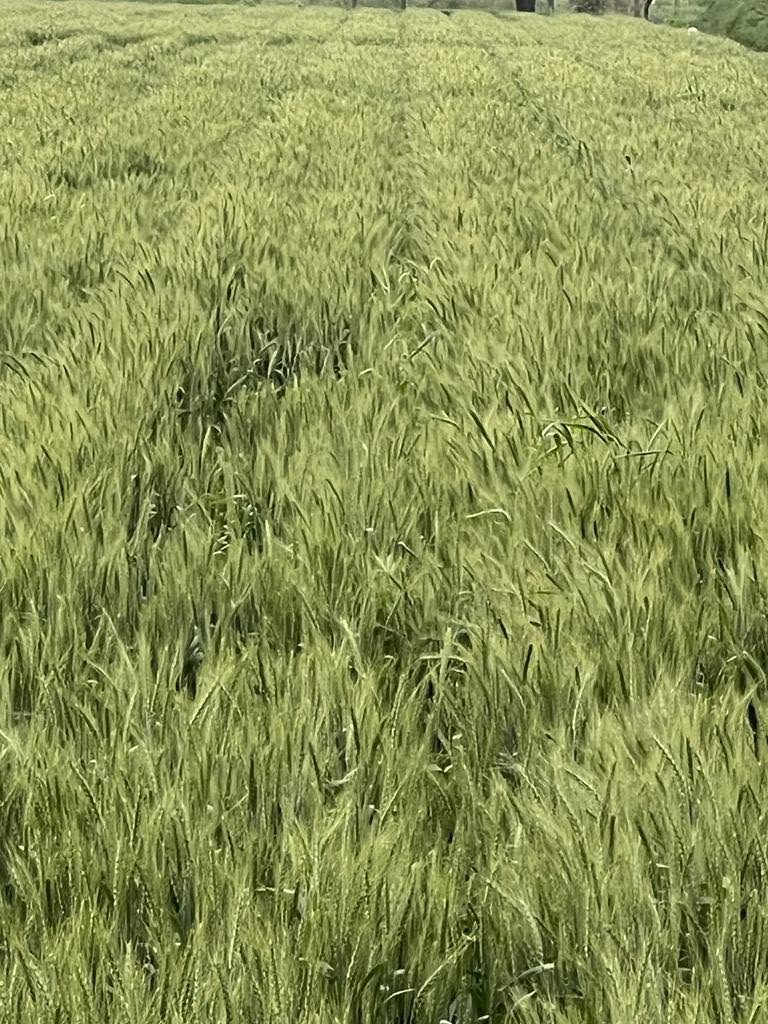
This checklist, revised September 2024 from Dr. Asif Sharif's wheat lectures, opens with land preparation: laser-level the field, rip the hardpan (typically 400-450 psi compaction, 12-14 inches thick in most fields) by deep ploughing, then water-wash to leach salts, using sulfuric acid (diluted 10 liters in 200 liters of water per acre) where soil pH exceeds 8 to convert chemical residues into salts that move below the root zone. Beds are then formed 42 inches wide with 5 lines of wheat per bed, mulched with live or dead cover, live preferred provided it stays shorter than the wheat.
The checklist's numeric core sets ideal spacing at 9 inches by 9 inches, targeting a plant population of 62,000 per acre averaging 35 tillers per plant, with a single well-spaced seed capable of producing 80-85 tillers under optimal conditions. A PQNK wheat panicle is stated to average 76 large grains against 60 smaller grains for conventional wheat, and PQNK grain weight runs roughly double conventional (8g vs. 4g per unit referenced in the source lectures). Because sowing in the recommended third week of September runs into residual heat, the checklist calls for pruning (up to three times) to keep the crop under 6-8 inches tall until January, with continuous sheep grazing preferred over goat grazing since sheep graze more uniformly and cause less soil disturbance, targeting 35 tillers per plant by the start of January.
On nutrition, the checklist argues against DAP and urea on cost-effectiveness grounds specific to their chemistry: DAP's phosphate component converts to inaccessible calcium phosphate within a week to ten days, while its urea component retains effectiveness for only 8-10 days, so the spend delivers little lasting benefit versus letting soil microbes mineralize the substantial native nutrient reserves already in the soil. A first-year PQNK crop showing yellowing is the one exception noted, where a 2% NPK foliar spray (applied morning or evening for 30-45 minutes of leaf absorption) is recommended as a corrective measure.
A national-scale yield comparison anchors the paper's economic case: using acre dimensions of 198 x 220 feet (40 beds across, 44 down, 8,800 running feet of bed), a target of 2 million wheat heads per acre at a minimum 60 seeds per head projects to roughly 5,454 kg, or about 136 maunds per acre, against Pakistan's national average of 28 maunds. The paper also notes multicropping compatibility (radish, vegetables, sugarcane, mustard, peas, and Lucerne intercropping) and reports that PQNK wheat has commanded an international 'Super Organic' price point of $600 per ton, against roughly $400 for certified organic and $200 for conventional wheat.
About This Paper
- Crop
- Wheat
- Problem
- Hardpan · Saline / Alkaline / High-pH Soil · Lodging / Weak Stem Structure · Yield Stagnation / Decline
- Science
- Soil · Plants · Economics
- Evidence
- Economic Model/Projection
- Authority
- Requires PQNK Review
Related PQNK Science
Key Takeaways
- Ideal spacing is 9in x 9in, targeting 62,000 plants/acre averaging 35 tillers per plant (up to 80-85 tillers from a single well-spaced seed).
- PQNK wheat panicles average 76 large grains versus 60 smaller grains for conventional wheat, with roughly double the grain weight reported in the source lectures.
- Hardpan compaction runs 400-450 psi at 12-14 inches thick in most fields; breaking it is treated as a prerequisite for the deeper root growth that improves lodging resistance.
- Height is capped at 6-8 inches until January via pruning/grazing (sheep preferred over goats for uniformity and lower soil disturbance), targeting 35 tillers/plant by January 1st.
- DAP and urea are argued to be poor value: DAP's phosphate converts to inaccessible calcium phosphate within 7-10 days, and its urea component's effectiveness lasts only 8-10 days.
- A national yield model projects roughly 136 maunds/acre (2 million heads/acre at 60+ seeds/head) against Pakistan's 28-maund national average; PQNK wheat has reportedly commanded a $600/ton 'Super Organic' price versus ~$400 organic and ~$200 conventional.
Related Crops
Related Knowledge
same problem
Chilli Production Under PQNK (PICNIC)
Chilli is biologically perennial and can remain productive for over a decade, but conventional short-cycle, urea-dependent management collapses that potential into a pest-prone annual grind. This paper shows how PQNK's soil-conversion framework and a single apical-pinching intervention restore chilli to a low-cost, high-density perennial crop, validated on a Hafizabad farm.
same problem
Breaking Hardpan Without Machinery
Written for small farmers without access to subsoiling equipment, this SOP treats hardpan as a symptom of interrupted biological function rather than a purely physical barrier, and lays out a six-step, machinery-free protocol, plus specific transitional expectations for wheat, pulses, and cotton, for repairing it entirely through roots, mulch, and time.
same problem
Balangu & Basil Seed Production Under PQNK
A complete Punjab-focused production guide showing how Balangu (Lallemantia royleana) and Basil seed crops are grown on PQNK's permanent raised-bed system, from hardpan-breaking through harvest and storage.
same problem
Knowledge Paper: PQNK Rose Production
Cut-flower rose production is reframed as a closed-loop perennial system under PQNK, reaching a striking 8,712 plants per acre on twin-row permanent beds, with weeds treated as mulch, alfalfa grown as living nitrogen-fixing ground cover, and strict soil-moisture management replacing scheduled irrigation.